

Stop Paying Penalties for Power You Almost Didn’t Use.
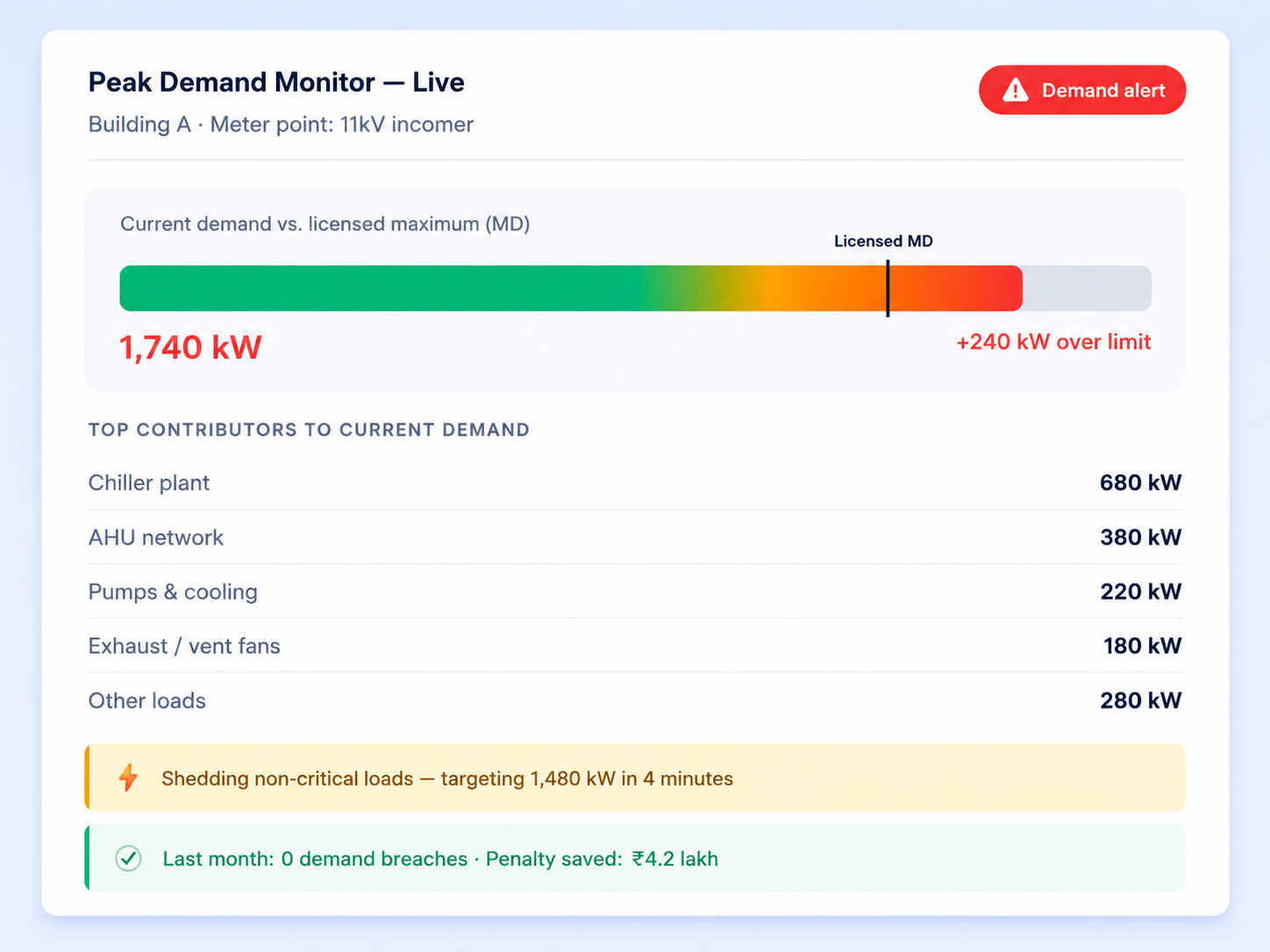
Every large building has a licensed maximum demand. Exceed it — even once, even briefly — and you pay a penalty for the whole month. SmarterHU monitors your demand in real time, predicts approaching peaks, and sheds load automatically before the breach is recorded.
Zero
Demand penalties with active control
15 min
The window that sets your monthly demand
Data
To right-size your MD licence
Auto
Load shedding before breach
Exceeding your MD costs you far more than you think.
Demand penalties aren’t just a line on the bill. They cascade into compliance costs, infrastructure obligations, and capital expenditure that compounds over years.
01. Demand Penalty Charges
02. Over-Licensing to Stay Safe
03. Substation Infrastructure Cost
04. Land & Civil Obligations
05. Compliance & Social Obligations
06. Demand Ratchet Clauses
It’s not about how much you consume. It’s about how much you pull at once.
Maximum demand is not your total monthly energy consumption — it’s the highest rate at which you draw power during any 15-minute window in the billing period. One spike on one morning can set your demand charge for the entire month.
01. How MD is measured
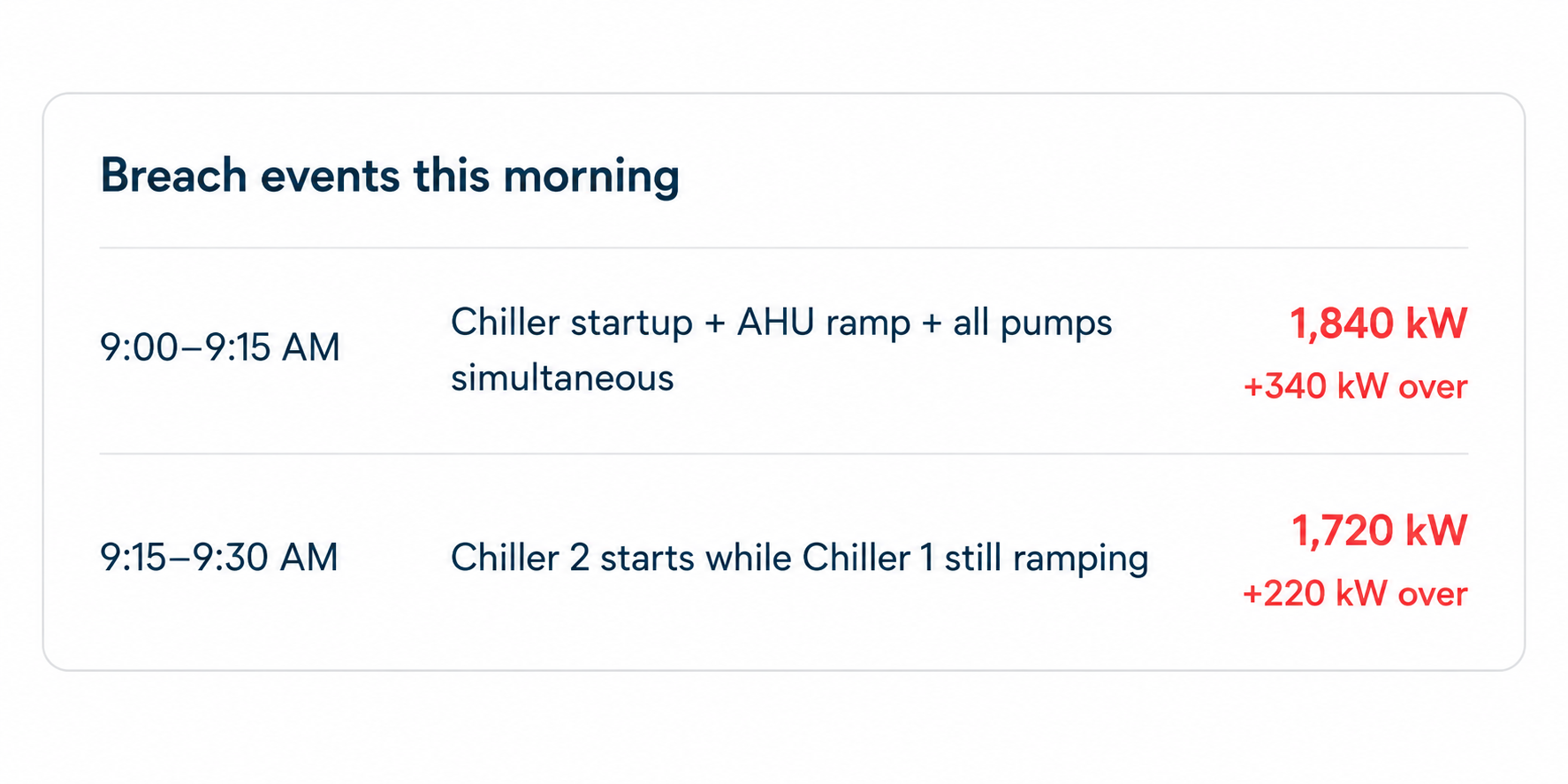
02. When breaches happen
03. The license you really need
The 15-minute window that changes everything
See exactly when and why your demand peaks.
Know your peak. Know its cause.
Most facility managers don’t know their actual peak demand profile — they see the monthly bill but not the hour-by-hour data behind it. SmarterHU gives you granular 15-minute demand data for every day, overlaid with individual machine contributions.
15-minute demand tracking
Machine-level demand attribution
Time-of-day peak patterns
Monthly demand history
Four ways SmarterHU keeps your demand within limits.
SmarterHU doesn’t just alert you when demand is high — it acts. Four automated strategies ensure your demand never exceeds its licensed limit.
Staggered Machine Startup
The single biggest cause of breaches is all machines starting simultaneously. SmarterHU staggers startup across 10–20 minutes — the demand spike simply never forms.
Prevents 70% of breaches
Real-Time Load Shedding
When demand trends toward the limit, non-critical loads are automatically shed — exhaust fans, ventilation, non-essential AHUs — before the 15-minute window closes.
Automated & instant
Predictive Demand Forecasting
Using historical patterns, current load data, and weather inputs, SmarterHU predicts when demand is likely to peak — and takes preventive action before the spike occurs.
Forecast-driven
Off-Peak Load Shifting
Moves non-time-critical high-demand operations — pre-cooling, pump scheduling, storage charging — to off-peak windows where demand headroom exists.
Tariff-aware
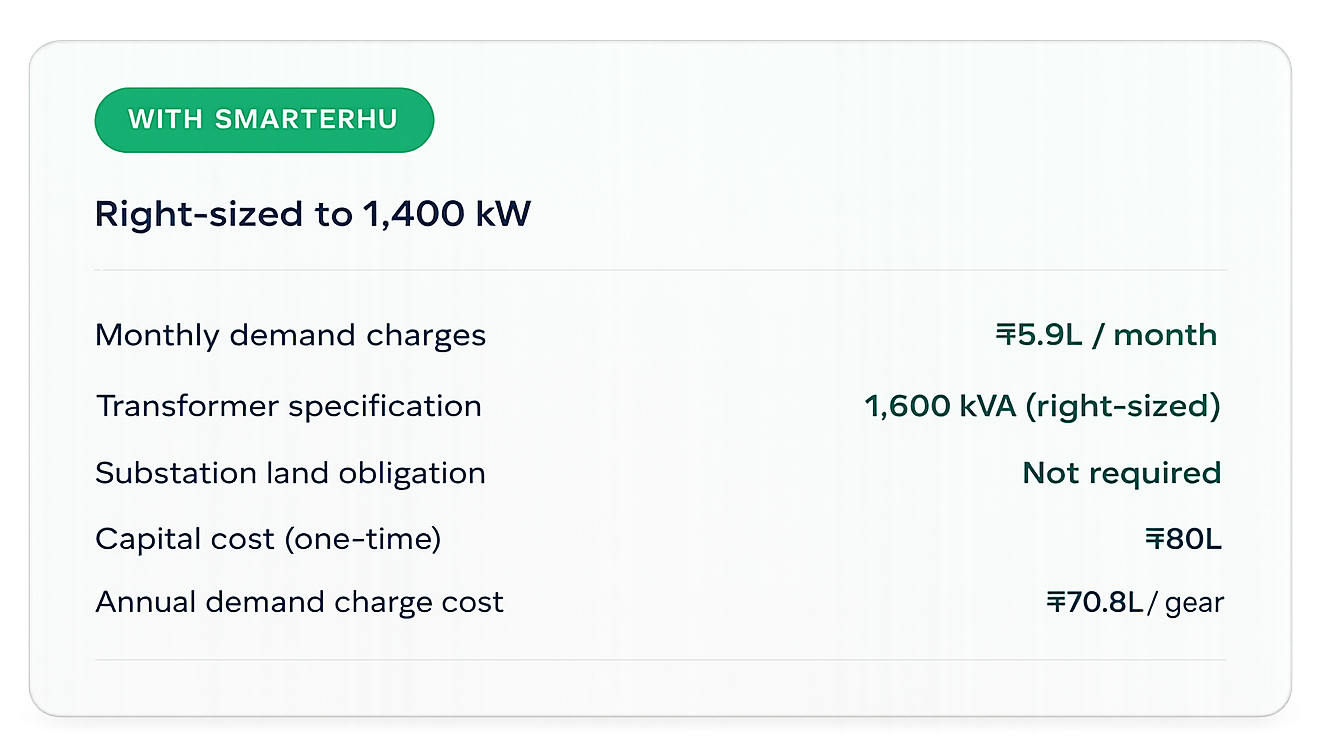
You may be licensed for more than you actually need.
Right-size your licence. Right-size your costs.
Your licensed MD determines more than demand charges. It sets the specification for your transformer, your switchgear, your substation — and in many cases, your obligation to dedicate land or pay for infrastructure on behalf of the utility.
With SmarterHU showing your real demand profile, you can approach your utility with data — not estimates — and negotiate a lower MD licence.


From meter to managed demand — automatically.
SmarterHU connects to your main incomer meter, profiles your demand, enforces limits proactively, and gives you the data to right-size your licence.
Connect the Incomer
Real-time demand readings every minute — the same measurement your utility uses, but available to you before they record it.
Build Demand Profile
15-minute data over weeks and months reveals your true peak patterns — which machines, what times, what triggers.
Enforce Demand Limits
When demand approaches the limit, load shedding and staggered startups activate automatically — keeping demand within limits.
Optimise the Licence
12 months of real data in hand, you negotiate with your utility to right-size the MD licence — cutting fixed charges and infrastructure costs.
Unmonitored demand vs. SmarterHU control.
Traditional Approach
Demand Control
You may be paying for demand
you’ve never actually needed.
Book a free demand assessment. We’ll analyse your meter data and show you your real peak demand profile — and exactly what it’s costing you unnecessarily.